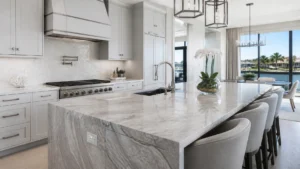
Marble countertops in Cape Coral offer a distinctive combination of natural veining, cool touch, and timeless elegance. They can be an excellent choice for Florida kitchens, bathrooms, and statement islands when you understand their maintenance needs and select the right finish for your lifestyle.
Why Marble Countertops in Cape Coral Continue to Attract Homeowners
Cape Coral homes often embrace an open, airy design inspired by Florida’s coastal setting. White cabinetry, soft gray accents, warm wood tones, and large windows create a clean backdrop for natural stone, and marble fits naturally into that aesthetic.
Unlike engineered materials with repeating patterns, every marble slab is unique. Its veining may be subtle and linear, bold and dramatic, or layered with gray, beige, brown, and gold movement. That variation gives your countertop a one-of-a-kind appearance and makes slab selection an important part of the remodeling process.
Current homeowner preferences in Southwest Florida commonly include:
- Light marble with soft gray veining for coastal kitchens
- Bold veined slabs as a focal-point island
- Marble vanity tops in primary bathrooms and powder rooms
- Honed finishes that create a softer, matte appearance
- Natural wood cabinetry paired with white or cream stone
- Marble-look alternatives for homeowners who prefer lower maintenance
Marble also has a naturally cool surface, which is useful for baking and comfortable in Florida’s warm climate. However, its beauty comes with responsibilities that you should consider before making a final selection.
Are Marble Countertops in Cape Coral Durable Enough for Florida Living?
Marble is a durable natural stone, but it is softer and more porous than granite and engineered quartz. That distinction matters because a countertop’s durability is not only about whether it can last for decades; it is also about how well it handles your household’s daily habits.
Marble performs well against normal kitchen heat, although using trivets is still a practical precaution. It can also last for many years when properly fabricated, installed, sealed, and maintained. The primary concerns are etching, scratching, staining, and edge damage.
Here is what those terms mean:
- Etching: A dull or lightly marked area caused by acidic substances reacting with the calcite in marble. Lemon juice, vinegar, wine, tomato, and some cleaners may cause etching.
- Porosity: The tiny spaces within natural stone that can allow liquids to penetrate if the surface is not adequately sealed.
- Patina: The lived-in character that develops as a natural stone surface experiences small changes over time.
- Honed finish: A matte or low-sheen finish that can make minor marks less noticeable than they may be on a high-polish surface.
For many Cape Coral homeowners, the key question is not whether marble can last. It is whether they are comfortable with a surface that may develop character through use.
Marble vs. Quartz vs. Granite: Which Countertop Is Right for You?
The best material depends on how you use your kitchen or bathroom, how much maintenance you want to perform, and the visual style you hope to create.
| Consideration | Marble | Quartz | Granite |
|---|---|---|---|
| Appearance | Natural veining and unique movement | Consistent options, including marble-inspired patterns | Natural flecks, movement, and color variation |
| Heat resistance | Good, but trivets are recommended | Use heat protection; resin content can be sensitive to high heat | Very good, though trivets are still wise |
| Stain resistance | Improved with sealing and prompt cleanup | Non-porous and highly stain-resistant | Strong when properly sealed |
| Etching risk | Higher, especially from acids | Generally not vulnerable to natural-stone etching | Lower than marble |
| Maintenance | Regular sealing and stone-safe cleaning | Minimal maintenance; no routine sealing | Periodic sealing may be needed |
| Best fit | Luxury baths, feature islands, careful home cooks | Busy kitchens and low-maintenance homes | High-use kitchens and natural-stone enthusiasts |
Marble is often a strong choice when visual impact is your top priority. Quartz may be more practical for a busy family kitchen, while granite provides a balance of natural beauty, durability, and everyday performance. For a deeper comparison, read Quartz vs. Granite vs. Marble: Which Countertop Is Right for Your Kitchen Remodel?.

Where Does Marble Work Best in a Cape Coral Home?
Marble can be used throughout a home, but certain applications make its advantages easier to enjoy while reducing exposure to heavy wear.
Bathrooms and Powder Rooms
Bathrooms are a popular application because vanity tops generally experience fewer cutting, cooking, and acidic-food exposures than kitchen counters. A marble vanity can coordinate with large-format wall tile, brushed metal fixtures, wood cabinetry, or a neutral coastal color palette.
In a primary bathroom, marble can also create a spa-like appearance without requiring you to cover every surface in a bold pattern. A smaller remnant may be a cost-conscious option for a powder room or guest bath.
Statement Islands
If you love the look of marble but want to limit maintenance, consider using it on an island while choosing granite or quartz for the perimeter counters. This approach allows the island to serve as the room’s design centerpiece while high-use prep areas receive a more forgiving surface.
Baking Stations
Marble’s naturally cool surface is valued by home bakers who roll pastry or work with temperature-sensitive dough. A dedicated baking area can provide the material’s functional benefit without exposing the entire kitchen to the same level of daily wear.
How to Care for Marble in Cape Coral’s Climate
Southwest Florida’s humidity, frequent entertaining, and indoor-outdoor lifestyle make consistent care important. The climate does not automatically make marble unsuitable, but moisture and spills should be managed carefully.
Follow these steps to protect your investment:
- Seal the surface as recommended. Top Granite & Marble recommends sealing marble at installation and resealing approximately every one to two years, depending on the stone, usage, and sealer. Your fabricator can provide a more specific maintenance schedule.
- Clean with a pH-neutral stone cleaner. Mild soap and water or a product designed for natural stone is usually appropriate. Avoid vinegar, lemon-based cleaners, bleach, and abrasive powders unless your stone professional specifically approves them.
- Blot spills promptly. Do not let coffee, citrus, wine, tomato, or oily products sit on the surface. Quick cleanup reduces the risk of staining and etching.
- Use cutting boards and trivets. Marble is not a cutting board, and hot cookware should be placed on a protective pad.
- Choose the finish thoughtfully. Honed marble can provide a softer look and may disguise minor surface changes better than polished marble.
- Discuss repairs early. Chips, stains, and etching may sometimes be improved by professional restoration, especially when addressed promptly.
The Natural Stone Institute’s consumer resources provide additional guidance on selecting and caring for natural stone.
How to Choose the Right Marble Slab
Before choosing a color, evaluate the entire slab rather than relying only on a small sample. Veining in marble countertops can look significantly different at full scale, particularly on a large Cape Coral kitchen island.
Consider the following:
- Bring cabinet, flooring, backsplash, and paint samples to the showroom.
- Decide whether you prefer subtle Carrara-style veining or dramatic Calacatta-inspired movement.
- Review how the pattern will flow across the island and perimeter counters.
- Ask where seams will be placed and how the layout will affect the appearance.
- Compare polished and honed finishes under natural and interior lighting.
- Confirm the recommended sealer and ongoing care requirements.
- Ask whether a remnant could work for a smaller bathroom project.
Top Granite & Marble offers a wide selection of granite, marble, and quartz from multiple suppliers, along with free estimates and free measuring. Every project is handled by the company’s own trained staff rather than subcontractors, from fabrication through installation.
Frequently Asked Questions
Are marble countertops a good choice for a Cape Coral kitchen?
Yes, if you value natural beauty and accept regular care. Marble is especially well suited to feature islands, baking areas, and kitchens where homeowners are comfortable using cutting boards, trivets, and stone-safe cleaners.
Does Florida humidity damage marble countertops?
Humidity alone does not make marble unusable, but moisture reinforces the importance of proper sealing and prompt spill cleanup. Your fabricator can recommend care based on the specific slab and installation.
Is honed or polished marble better?
Polished marble offers a lustrous surface that highlights veining, while honed marble has a softer matte appearance and may make minor marks less visually prominent. The better option depends on your design preferences and tolerance for visible wear.
How often should marble be sealed?
Many marble installations are resealed every one to two years, but the correct schedule depends on the stone’s porosity, sealer, and use. Ask your countertop professional for a recommendation rather than relying on a fixed calendar alone.
Can marble increase a home’s value?
High-quality natural stone can contribute to a home’s appeal and perceived finish level, particularly when it complements the design and has been well maintained. It should be viewed as a long-term design investment, not a guaranteed return on investment.
Bring Timeless Marble Style to Your Cape Coral Home
Marble countertops in Cape Coral can deliver the elegant veining, cool surface, and natural character that suit Florida’s bright, relaxed interiors. They are not maintenance-free, but with thoughtful placement, proper sealing, and realistic expectations, marble can remain a beautiful part of your home for years.
Top Granite & Marble has served Southwest Florida since 2012, providing custom fabrication and installation for kitchens, bathrooms, remodels, new construction, and commercial projects. Visit the Port Charlotte showroom at 4280 James St., Unit 2/3, Port Charlotte, FL 33980, call (941) 421-5244, or contact the Fort Myers team at (239) 703-3732.
When you are ready to compare slabs and discuss your project, request a free estimate or learn more about marble countertops.